General information only, not personalized financial advice. Disclaimer.
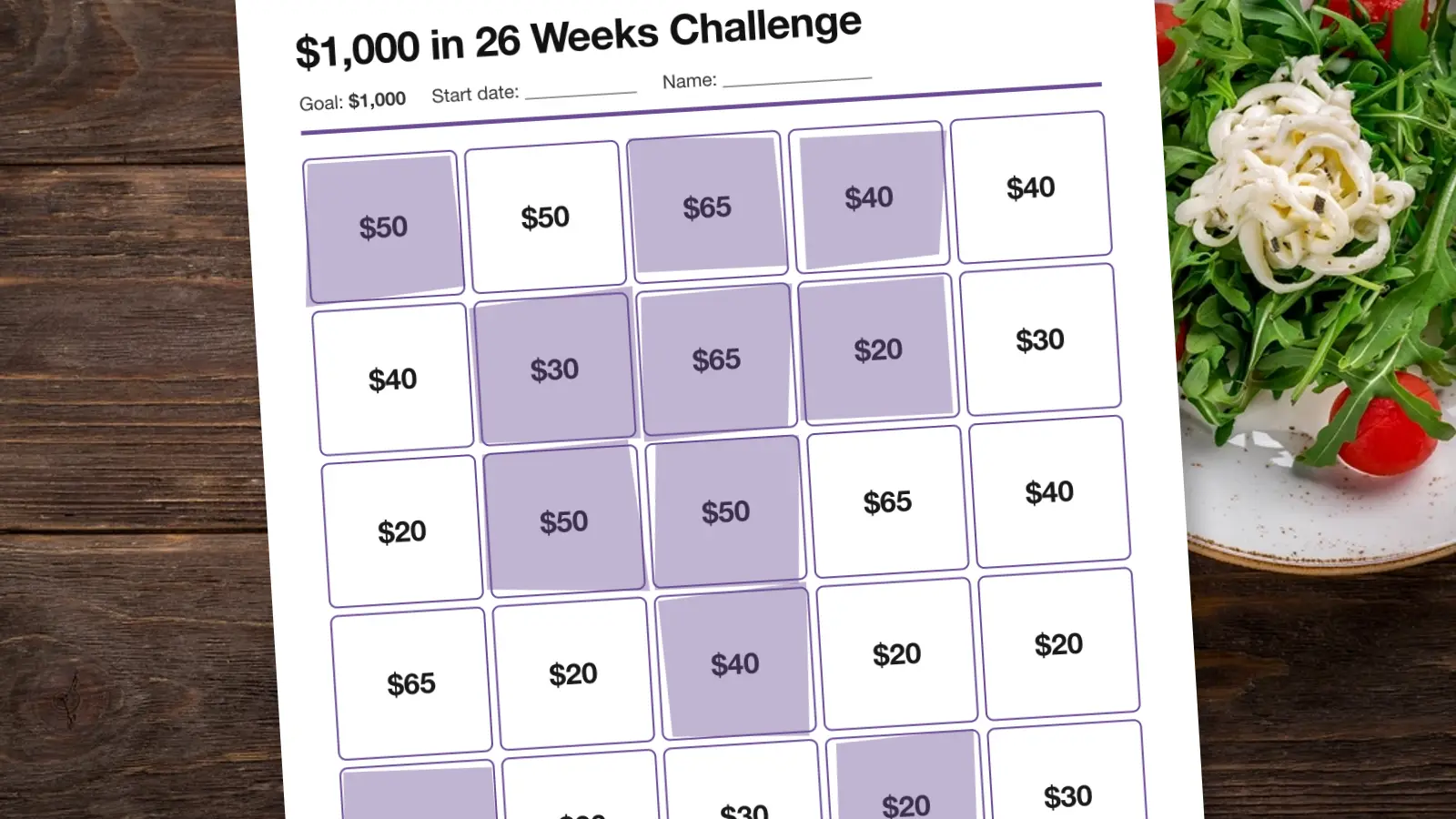
To save $1,000 in 26 weeks, set aside about $38.46 a week — or $76.92 every two weeks if you’re paid biweekly. Our free tracker splits the $1,000 into 26 squares from $20 to $65, so you can match the amount to the week you’re having.
It’s a six-month challenge, which makes it a great first step before a full-year challenge like the $5,000 in 52 weeks.
Step 1: Print the tracker
Open the $1,000 in 26 weeks printable and print it or save it as a PDF. It has 26 squares:
| Square | How many | Subtotal |
|---|---|---|
| $20 | 6 | $120 |
| $30 | 6 | $180 |
| $40 | 6 | $240 |
| $50 | 4 | $200 |
| $65 | 4 | $260 |
| Total | 26 | $1,000 |
Step 2: Pick where the money goes
Open a separate savings account (or a labeled “bucket” in your bank app) so the money isn’t sitting next to your spending. Check that the bank is FDIC-insured (or NCUA-insured for a credit union). Name it something motivating — “$1K by July” works.
Step 3: Choose your rhythm
- Paid weekly: one square a week.
- Paid every two weeks: two squares per payday. Pair a big one with a small one ($65 + $20 = $85, $40 + $30 = $70) so every payday asks for a similar amount.
- Paid monthly: four or five squares on payday, then you’re done for the month.
Step 4: Follow a simple plan (example)
Here’s one way to order the squares if you start on January 1, 2027 and get paid every two weeks:
| Months | Squares to shade | Saved by the end |
|---|---|---|
| January | $65, $50, $40, $40 | $195 |
| February | $65, $50, $40, $30 | $380 |
| March | $65, $40, $30, $30 | $545 |
| April | $65, $50, $40, $20 | $720 |
| May | $50, $40, $30, $30, $20 | $890 |
| June | $30, $20, $20, $20, $20 | $1,000 |
Big squares go early, while motivation is high. June is the easy finish.
Step 5: Shade, transfer, repeat
The order matters: transfer first, then shade. A shaded square with no transfer is just coloring.
Step 6: Plan for the bad week
At some point a car repair or a birthday will land on a payday. When that happens, shade a $20 square and move on. If you skip a week entirely, add $10 to the next four weeks. Don’t restart.
Where to find $38 a week
- Pause or rotate two subscriptions (use the subscription cost calculator).
- One fewer takeout meal a week.
- Swap the three priciest items on your grocery receipt (20 cheap swaps).
- Sell one unused item a week on Facebook Marketplace or a local selling app.
What to do with the $1,000
A common first goal is a starter emergency fund — read how to build one on a low income. Once it’s there, you can start the next challenge with a bigger target.
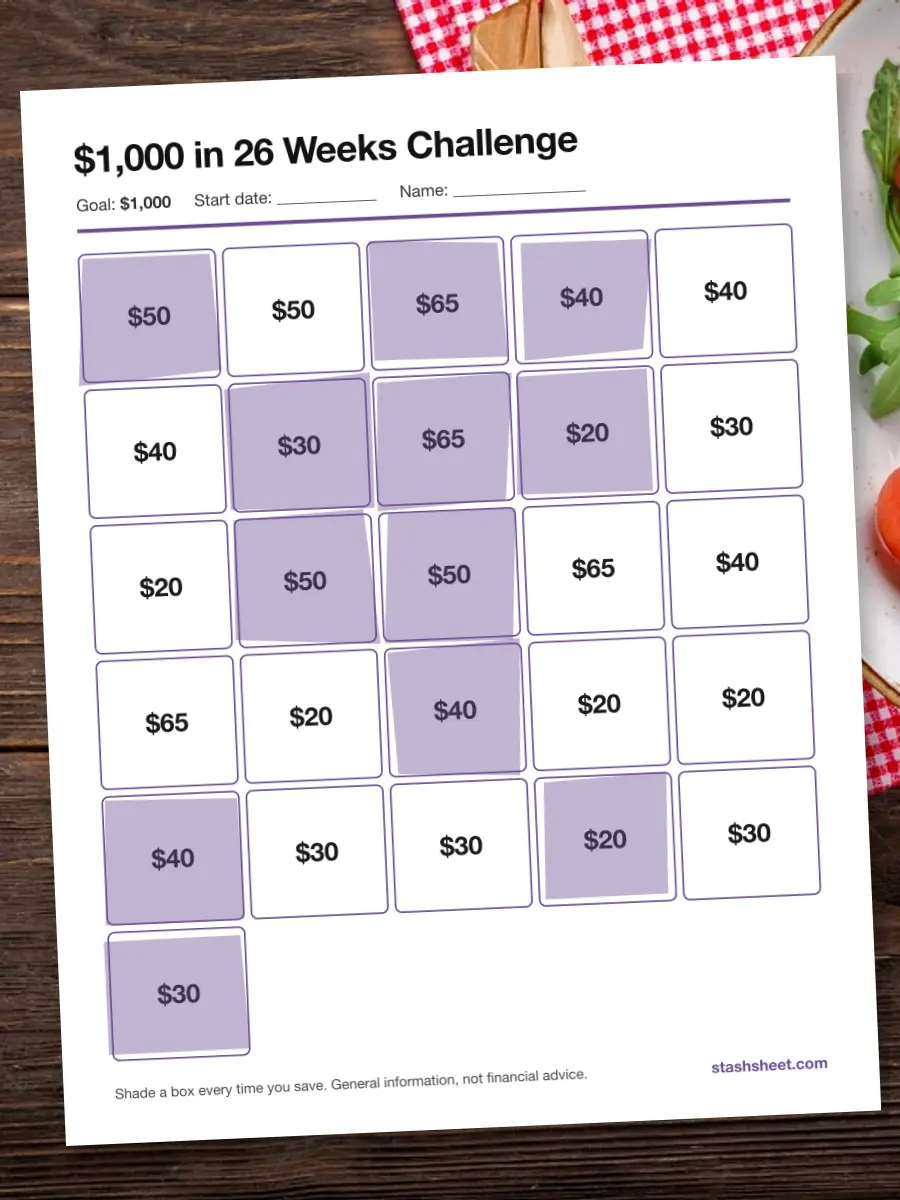
$1,000 in 26 Weeks Challenge
A gentler six-month challenge: 26 squares from $20 to $65. Perfect for an emergency-fund starter or a summer trip. Free one-page PDF, no email needed.
Download free PDF PreviewFrequently asked questions
How much do I need to save each week to get $1,000 in 26 weeks?
About $38.46 a week on average, or $76.92 every two weeks. The printable uses squares from $20 to $65 so some weeks are easier than others.
Is 26 weeks a good length for a first savings challenge?
Yes. Six months is long enough to build the habit and short enough to stay motivated, and $1,000 is a common first emergency fund goal.
Sources
- CFPB: Building your savings? Start with small goals (PDF booklet)
- CFPB: Looking for an easy way to save money? Make it automatic
- FDIC: Understanding deposit insurance
These are official, free resources. This article is general information, not personalized financial advice — for decisions about your own money, talk to a licensed professional or a nonprofit counselor.